
National oil companies are swimming with the downward current in the stock market, which plummeted to psychological level of below 10,000.

The 17th daily increase in rates, since oil companies on June 7 restarted revising prices in line with costs after ending an 82-day hiatus in rate revision, has taken diesel prices to fresh highs.

'Could the impending new crisis, vibe coding, similarly create not a disaster like what befell Indian handlooms during the Industrial Revolution but another opportunity like what the Y2K crisis created?' asks Ajit Balakrishnan.

More than half of the total subsidy provisioning, amounting to 54 per cent, is going towards food subsidy, which is estimated at Rs 184,220 crore for 2019-20 - a 7.5 per cent increase over the revised estimates for 2018-19.

IOC and other oil firms have been paying LPG consumers in 54 districts up to Rs 500 to help them buy a 14.2-kg cooking gas refill at market price, which is more than double of Rs 410 per bottle rate in Delhi.

The October-December quarter (Q3FY25) results of fast moving consumer goods (FMCG) major Hindustan Unilever (HUL) indicated weak demand, with urban growth muted and rural showing recovery. Consolidated revenue grew by 1.6 per cent (volume was flat) to Rs 15,818 crore, due to price hikes. Prices of key raw materials such as palm oil and tea remained elevated, leading to compression of gross margin.

National oil companies are staring at inventory losses as they have to bring down refinery throughputs because of the plunging demand for fuels following the nationwide lockdown to contain the deadly coronavirus infection. India is the world's third-largest energy consumer but the lockdown has shut businesses, suspended flights, stopped trains and brought almost the entire vehicular movement to a halt, impacting fuel demand.

IOC urged the government to cut excise duty by Rs 8 (the current revenue loss) to Rs 6.78 per litre. It also demanded a cut in state-level taxes.
Cairn India is actively considering the option of evacuating its crude oil from Rajasthan through Viramgam in Gujarat

The performance of banking and information technology (IT) stocks has had a significant impact on the composition of diversified mutual fund (MF) portfolios. Over the past two months, these sectors have become increasingly dominant, now constituting nearly 30 per cent of the total allocation in many diversified MF portfolios.

'As the global economy undergoes significant transformations in 2025, India's ability to navigate the complexities of trade wars, financial realignments, and emerging blocs will be pivotal,' explain Harsh V Pant and Soumya Bhowmik.

India's import of cheap Russian oil scaled another record in May and is now more than the combined oil bought from Saudi Arabia, Iraq, UAE and the US, industry data showed. India took 1.96 million barrels a day from Russia in May, 15 per cent more than the previous high in April, according to data from energy cargo tracker Vortexa. Russia now makes up for nearly 42 per cent of all crude oil India imported in May.
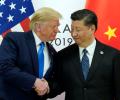
Trump spoke approvingly of his recent telephone conversation with Xi Jinping. This could indicate the possibility of America and China reaching some level of tactical accommodation, which would not be good news for India, points out Ambassador Shyam Saran, a former foreign secretary.

RBML - the joint venture of Reliance Industries Ltd and supermajor BP - has told the government that fuel retailing for the private sector in India has become unsustainable after market-controlling public sector firms frequently froze petrol and diesel prices at rates way below the cost, sources said. Despite a surge in oil prices, state-owned Indian Oil Corporation (IOC), Hindustan Petroleum Corporation Ltd (HPCL) and Bharat Petroleum Corporation Ltd (BPCL) first froze petrol and diesel rates for a record 137 days beginning early November 2021 when five states including Uttar Pradesh went to the polls, and last month again went into a hiatus that is now 47 days old. "They (Reliance BP Mobility Ltd) has written to the petroleum ministry over the fuel pricing issue," a highly placed source in the government, who didn't want to be quoted, told reporters.

'Our business continues to roll out its strategy, the role of this GDTC continues to grow.'

Disappointing quarterly earnings numbers and revenue forecast from IT services company Wipro also weighed on investor sentiments. The 30-share BSE Sensex fell 247.78 points or 0.38 per cent to settle at 65,629.24 points. During the day, it plunged 533.52 points or 0.80 per cent to 65,343.50 points.
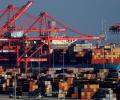
Senior officials of India and the US will begin three-day talks on the proposed bilateral trade agreement in New Delhi on Wednesday amid threats of reciprocal tariffs from the Trump-administration, an official said. To formally start the negotiations on the pact, Assistant US Trade Representative for South and Central Asia Brendan Lynch, along with a team of officials, is in New Delhi.
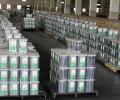
Billionaire Gautam Adani's group on Monday announced its exit from FMCG joint venture Adani Wilmar by selling its entire stake to the Singaporean partner and in the open market for an estimated over $2 billion in a first major deal since the US bribery indictment. In a statement, Adani Enterprises Ltd -- which held 43.94 per cent stake in Fortune brand cooking oil, wheat flour and other food product maker Adani Wilmar Ltd -- said it will sell 31.06 per cent stake to Wilmar International. About 13 per cent will be sold in the open market to meet minimum public shareholding requirements.

The Swachh Bharat Abhiyan -- or Clean India Mission -- was launched by Prime Minister Narendra Modi on October 2.

Industrial production and inflation data, quarterly earnings from IT majors and global trends would drive the equity markets in a holiday-shortened week, analysts said. Moreover, foreign fund trading activity, movement of the rupee and global crude oil prices would also dictate terms in the market, they added. Equity markets would remain closed on Friday for 'Dr Baba Saheb Ambedkar Jayanti'.

The other prominent gainers were Tech Mahindra, HCL Technologies, Wipro, State Bank of India and Larsen & Toubro. Bajaj Finserv, Power Grid, UltraTech Cement and HDFC Bank were among the laggards.

The slowdown in private consumption in the economy is taking a toll on the growth of fast-moving consumer goods (FMCG). The net sales growth of listed FMCG companies hit a 14-quarter low of 2.5 per cent in October-December 2023 (Q3FY24). This is the lowest revenue growth for the industry since the June 2020 quarter, when the FMCG firms in the Business Standard sample had reported a 13.2 per cent Y-o-Y decline in combined net sales owing to the lockdown.

'The market should maintain optimism on the back of range-bound oil prices, a robust fiscal balance sheet, a better-than-expected monsoon, and moderating inflation.'
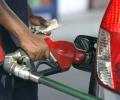
For every rupee fall against the dollar, the under-recovery will increase by Rs 8,000 crore

Petrol and diesel are among the 90-plus commodities that have been approved by the government for derivatives trading

A piece of slightly negative news can cause a serious setback, warns Debashis Basu.

Ahead of assembly polls in states like Rajasthan and Delhi, Oil Minister M Veerappa Moily on Tuesday said his ministry is mulling withdrawing the order that made it mandatory for state public transport utilities to buy diesel at market price.
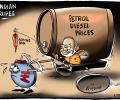
In five hikes, petrol price has gone up by Rs 2.74 per litre and diesel by Rs 2.83.

'The biggest near-term risk to Indian equities is the outflow of investments to China as tactical trades by foreign investors.'

Refuting all the allegations, IOC has clarified that no monopolistic situation exists in supply and pricing of aviation turbine fuel (ATF) to airlines.

Bank shares were the top gainer in early trades with Bank of Baroda up over 4%.
Manufacturing companies have been outperformers on the bourses in the current year, leading to a rise in their weighting in the benchmark index. Companies in sectors such as FMCG, automobile, pharmaceuticals, metals, cement, and agrochemicals now account for 25.43 per cent of the Nifty 50 index, up 88 basis points from 24.55 per cent at the end of December last year and a record low of 23.1 per cent at the end of CY20. The manufacturing sector is now dominated by FMCG majors such as Hindustan Unilever, ITC, Asian Paints, Nestle, and Britannia, accounting for 45 per cent of the combined market cap of all manufacturing companies in the index.

Tata Steel, Bajaj Finance, Mahindra & Mahindra, JSW Steel, NTPC, Adani Ports, Bajaj Finserv and Larsen & Toubro were also among the laggards. However, Power Grid, HCL Technologies, Infosys, Tech Mahindra, Tata Consultancy Services and ICICI Bank were among the gainers.

Financials were the top losers while oil shares also declined amid weak crude oil prices.

India and the United States will finalize the contours, schedule of negotiations, and terms of reference for a proposed bilateral trade agreement (BTA) during a three-day meeting beginning Tuesday. The agreement is expected to be finalized in two tranches, with the first phase focusing on goods trade. The US team, led by Assistant US Trade Representative for South and Central Asia Brendan Lynch, will be in India from March 25-29 to discuss the agreement. Both countries are aiming to conclude the first phase of the agreement by fall 2025.
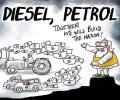
The government on Friday slapped an export tax on petrol, diesel and jet fuel (ATF) while also joining nations like the UK in imposing a windfall tax on crude oil produced locally. A Rs 6 per litre tax on export of petrol and ATF and Rs 13 per litre tax on export of diesel is effective from July 1, finance ministry notifications showed. Additionally, a Rs 23,250 per tonne tax was levied on crude oil produced domestically.

Brokerages expect Nifty50 companies to have cumulatively witnessed strong double-digit growth in their earnings in the first quarter of FY24 (Q1FY24). This growth in the combined earnings is expected to have been driven by banks, automakers, and oil & gas companies. Other sectors may report muted profit growth.

Jiomart B2B is the latest among organised supply-chain companies to bite the bullet, shutting down its warehouses, and asking its employees to leave. Why are companies finding it difficult to sustain the supply-chain business? Experts point out that gross margins in supplying fast-moving consumer goods (FMCGs) are very low.
